
The "Ghosted Lead" Sequence: How to Revive Cold Creative Finance Deals on Autopilot
Stop leaving money in your CRM. When creative finance leads ghost, they are usually just overwhelmed. Use this 3-part automated email and text sequence to leverage market shifts, trigger loss aversion, and revive cold Subject-To or seller finance deals on autopilot.

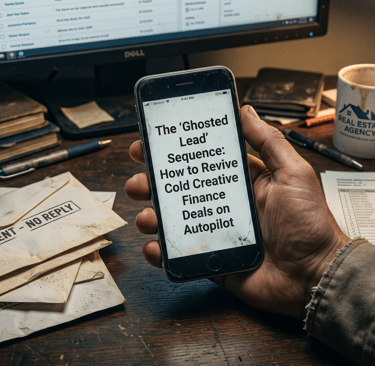
You know the feeling.
You spent a solid hour on the phone with a seller. You dug into their pain points, ran the numbers on their mortgage balance, figured out their PITI, and put together a creative offer that actually made sense for both of you — a clean Subject-To or seller finance deal, structured to win. They seemed into it.
Then nothing.
Texts go unanswered. Calls hit voicemail. They vanished.
Most wholesalers fold after the second or third ignored follow-up. They chalk it up to a dead lead, archive the contact, and go drop more money on a new list. That's a mistake — especially in creative finance. These deals rarely close on the first call because you're essentially asking a seller to think like a bank. That takes time.
If you're letting ghosted creative leads collect dust in your CRM, you're bleeding deals that are closer than you think. Here's how to build a simple 3-part automated (or semi-automated) revival sequence that uses market conditions and seller psychology to bring those conversations back to life.
Why Creative Leads Ghost — And Why You Shouldn't Give Up
When a cash buyer ghosts you, it's almost always about price. When a creative finance seller ghosts you, it's almost always about overwhelm.
Subject-To deals, seller finance, wraps, lease options — these aren't concepts most sellers encounter every day. They need time to loop in a spouse, Google "what is Subject-To," or just sit with the idea of leaving their name on a mortgage. While they're overthinking it, anxiety creeps in and they go quiet.
The mistake is treating silence as rejection. More often, it's hesitation. And hesitation has a cure: consistent, low-pressure follow-up that lets the market — and their next mortgage statement — do most of the convincing for you.
The 3-Part "Ghosted Lead" Revival Sequence
Trigger this sequence in your CRM the moment a lead goes cold — typically 7 to 10 days after your offer with zero response. Email steps can run fully automated. SMS works best semi-automated: your CRM drafts the message, a VA or acquisition agent hits send to stay compliant.
Message 1: The Problem Reminder
Send on: Day 1 of the sequence (roughly 7 days after last contact) Channel: Email + SMS Goal: Re-engage by bringing their problem back to the surface — not your offer.
Don't open with "Did you get a chance to look at the contract?" They know they didn't. Instead, remind them of the exact headache they told you they wanted to get rid of.
Email Subject: Quick question about [Property Address]
Hi [Seller Name],
Life gets busy — totally get it. Just a quick one:
Last time we talked, you mentioned that managing the monthly payment on [Property Address] had become a real headache. Are you still looking to get out from under that, or have your plans changed?
Either way, just let me know.
— [Your Name]
SMS Version:
Hey [Seller Name] — quick check-in on [Property Address]. Still looking to get rid of that monthly mortgage payment, or did you decide to hold onto it?
Why it works: You're not chasing the deal — you're checking on their problem. Giving them two clear options (still interested vs. moved on) makes it easy for them to respond without feeling pressured.
Message 2: The Market Reality Check
Send on: Day 5 of the sequence Channel: Email only Goal: Create soft urgency by using market conditions as context.
Five days later, the seller may still be quietly hoping a retail buyer materializes and pays full price, cash. This email is a gentle reality check — and a reminder of exactly why your offer sidesteps all the traditional headaches.
Email Subject: Update on [Property Address] + what I'm seeing in the market
Hi [Seller Name],
Just wanted to share something I've been keeping an eye on.
With interest rates still moving around and homes sitting on the market longer, a lot of traditional buyers are backing out of deals or coming in low. It's creating real headaches for sellers counting on a clean retail sale.
The structure we talked about — where we take over the monthly payments directly — bypasses all of that. No bank, no appraisal, no buyer financing falling through at the last second.
We're still in a position to move forward on [Property Address] if you are. Would you have 5 minutes this week for a quick call or text to see if we can make it work?
— [Your Name]
Why it works: It positions you as informed and stable — not desperate. It uses current market conditions to validate why a creative deal makes sense right now, without lecturing.
Message 3: The Takeaway
Send on: Day 12 of the sequence Channel: Email + SMS Goal: Trigger loss aversion. Make them feel like they're about to miss the window.
This is the most powerful message of the three. People are wired to react harder to losing something than to gaining something. Telling a seller you're closing their file activates that instinct immediately.
Email Subject: Closing out your file — [Property Address]
Hi [Seller Name],
Since I haven't heard back, I'm going to assume you've either made other arrangements or decided to hold onto [Property Address] for now — totally understandable either way.
I'm going to go ahead and close out your file on our end so we can put that capital toward another property in the area.
If anything shifts down the road, feel free to reach out. Genuinely wishing you the best.
— [Your Name]
SMS Version:
Hey [Seller Name] — haven't heard back, so I'm assuming you've made other plans for [Property Address]. Going to close your file today. Best of luck with it!
Why it works: The pressure is completely off — which, counterintuitively, is what makes people respond. It's common to get a reply within 10 minutes: "Wait, sorry — I've been out of town. Can we still talk?"
Setting This Up in Your CRM Without Losing Your Mind
Don't manage this by hand. Here's how to run it cleanly:
Create a dedicated pipeline stage. Name it something like "Creative Nurture – Ghosted" or "Offer Made – No Response." Anything that makes it obvious what this lead is waiting on.
Set an automation trigger. When a lead moves into that stage, the sequence launches automatically. No manual kickoff required.
Build an exit condition. If the seller replies at any point — by text, email, or call — the sequence stops immediately. You don't want a breakup email hitting someone who just responded to your first message.
Assign SMS tasks if you're going semi-automated. Have your CRM push a task to your VA or acquisition agent that reads: "Send Ghosted SMS #1 to [Seller Name]." They copy, paste, send. Done.
The Bottom Line
In creative finance, your CRM isn't a filing system — it's a revenue protection tool. A ghosted lead isn't a dead lead. It's a lead that hasn't had a reason to respond yet.
Set up this 3-part sequence once, let it run, and you'll stop hemorrhaging deals that were closer than they looked. Your job becomes simpler: close the people who raise their hands. Let the system handle everyone else.